


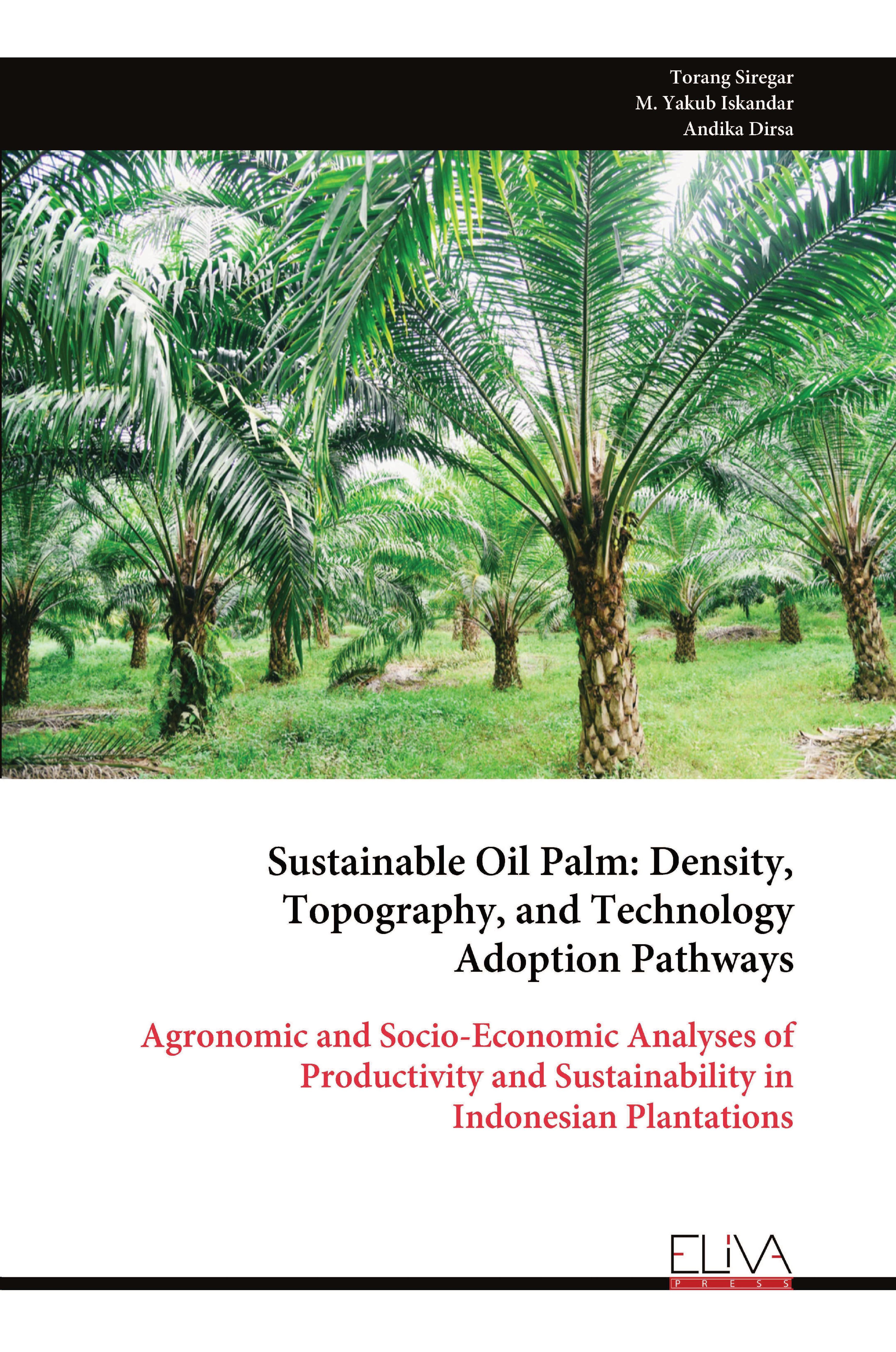
Sustainable Oil Palm: Density, Topography, and Technology Adoption Pathways
$ 99
Description
Leave review
Description
Can the world's most efficient oil crop also be its most sustainable?
Oil palm produces more vegetable oil per hectare than any other crop, yet its expansion has been linked to deforestation, biodiversity loss, and social conflict. In Indonesia, the world's largest producer, this tension between productivity and sustainability defines one of the most consequential agricultural policy debates of our time.
Sustainable Oil Palm: Density, Topography, and Technology Adoption Pathways brings together rigorous field research, comprehensive historical analysis, and practical policy recommendations to chart a viable course forward. Drawing on five years of longitudinal data from North Sumatra, this book:
Demonstrates that optimized planting densities of 130–136 palms per hectare consistently outperform conventional higher densities in productivity, input efficiency, and reproductive performance—offering a concrete pathway to sustainable intensification.
Reveals that appropriate management practices can neutralize topographic constraints on marginal and sloping lands, challenging assumptions about the inherent limitations of S3 suitability areas.
Identifies education, extension contact, and credit access as the key levers for improving technology adoption and technical efficiency among smallholders, with potential output gains of 34% without additional inputs.
Examines the historical roots of deforestation and the contemporary governance challenges facing certification schemes, providing evidence-based recommendations for policy reform.
Written for agronomists, development economists, environmental scientists, policymakers, and plantation managers, this book offers a balanced, evidence-based assessment of how the oil palm sector can meet rising global demand while respecting environmental limits and supporting rural livelihoods. It argues that sustainable intensification—achieving more with less—is not only possible but already being demonstrated on farms and estates across Indonesia.
For anyone who seeks to understand how the world can feed and fuel itself without destroying the forests on which we all depend, this book is essential reading.